
Why the night sky is dark
The night sky is dark because the universe is expanding and has a finite age. Starlight has not filled every line of sight.
Listen is a Plus feature Upgrade
Listening is not supported in this browser.
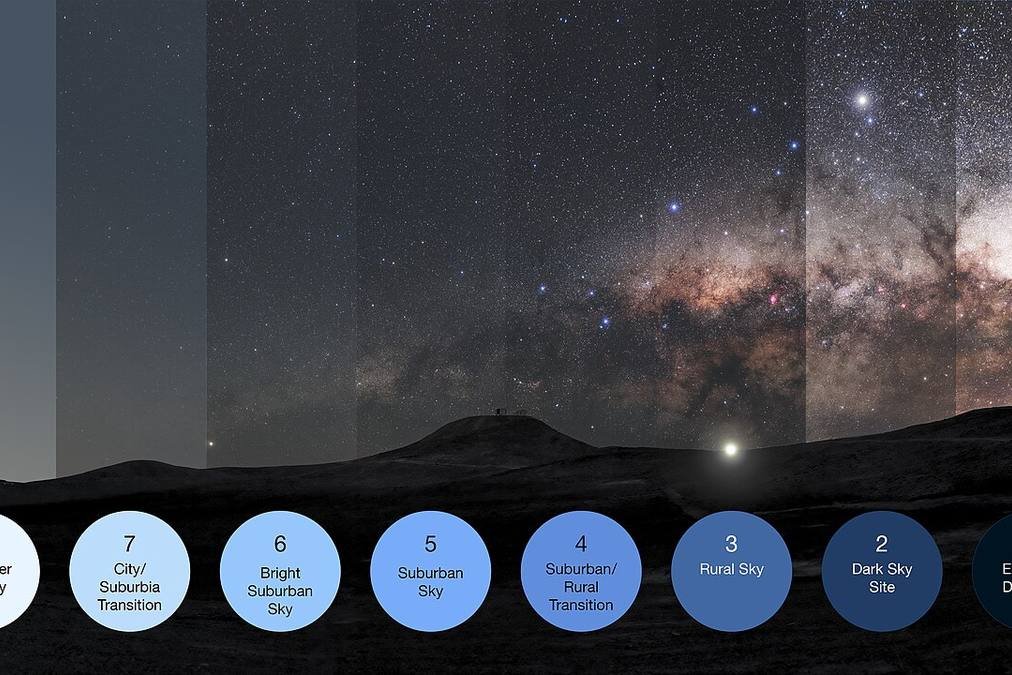
If the universe were infinite, eternal, and evenly filled with stars, every line of sight would end on a star. The night would be as bright as the surface of a star. It is not. That contrast is Olbers’ paradox.
The paradox assumes light from every distance has had time to arrive, and that the stars have always been there. Those assumptions are wrong for the universe we observe.
An old puzzle
The universe has a finite age. Light travels at a finite speed. We can see only the stars and galaxies whose light has had time to reach us. Beyond that horizon there is nothing we can yet receive, however many objects exist.
The universe is also expanding. Light from distant galaxies is stretched to longer, redder wavelengths. Much of the energy that left those galaxies arrives as infrared and radio waves, not as visible light the eye reads as a glow.
Age and expansion
Dust can hide individual stars, but dust that absorbed starlight for an infinite time would itself heat up and glow. Dust alone does not solve the paradox. The age and the expansion do.
So the dark between the stars is informative. It is evidence that we do not live in an eternal, unchanging sea of suns. There is a horizon to how far starlight has travelled.
An old puzzle
The night sky is dark because the universe is expanding and has a finite age. Starlight has not filled every line of sight. If the universe were infinite, eternal, and evenly filled with stars, every line of sight would end on a star. The night would be as bright as the surface of a star.
Put those two statements side by side. The first sets the condition. The second says what happens once that condition is met. Why the night sky is dark needs both. Drop the first and the second has nothing to explain. Drop the second and the first is only the scene.
Age and expansion
The night would be as bright as the surface of a star. It is not.
The order is the explanation. What the first sentence names has to be there before the result in the second sentence can show up. The piece does not ask you to accept the result first and hunt for a cause afterwards.
A check you can make
It is not. That contrast is Olbers’ paradox.
A fair check is sequential. Confirm the first statement. Then see whether the second is the result of it, rather than a separate fact parked in the same piece. If the result shows up without the condition, this account does not cover what you are looking at.
The limit of the claim
That contrast is Olbers’ paradox. The paradox assumes light from every distance has had time to arrive, and that the stars have always been there.
The two statements do different jobs. One says what is there, what it is made of, or what acts on it. The other says the change that follows. The title names the change. It is not an inventory of parts.
The same steps, in order
The paradox assumes light from every distance has had time to arrive, and that the stars have always been there. Those assumptions are wrong for the universe we observe.
Nothing in the second statement cancels the first. It carries the first forward or marks the limit of it. Remember only the result, and the cause goes missing. Remember only the cause, and you will not know what the piece says happens next.
Why the order matters
Those assumptions are wrong for the universe we observe. The universe has a finite age.
Read them as one path. Start at the first full stop and do not skip to the outcome. The words between the two statements are the mechanism. The title is the name of that path, not a second claim.
Condition, then outcome
The universe has a finite age. Light travels at a finite speed.
The first statement can be true and still not finish the job. The second statement is the job finishing. Hold both, and the paragraph above stops being a list. It becomes the reason the title is worded as it is.
No correction has been appended to this story. If a line is wrong, tell the newsroom.